


Overview
There will often be instances in which fees may need to be refunded. This is the place where a list of refundable fees can be set up.
Refundable Fees are very similar in structure to Fees, which, in most cases (but not all), are set up before Refundable Fees. Refundable fees, like fees, also involve various types (fixed cost, per unit or per work field), structures (flat or tiered), and measures (e.g. unit numbers, area, etc.). If you have already set up Fees, setting up Refundable Fees will involve a near-identical process.
- Click +Add ❶. The New Fee dialog box appears:
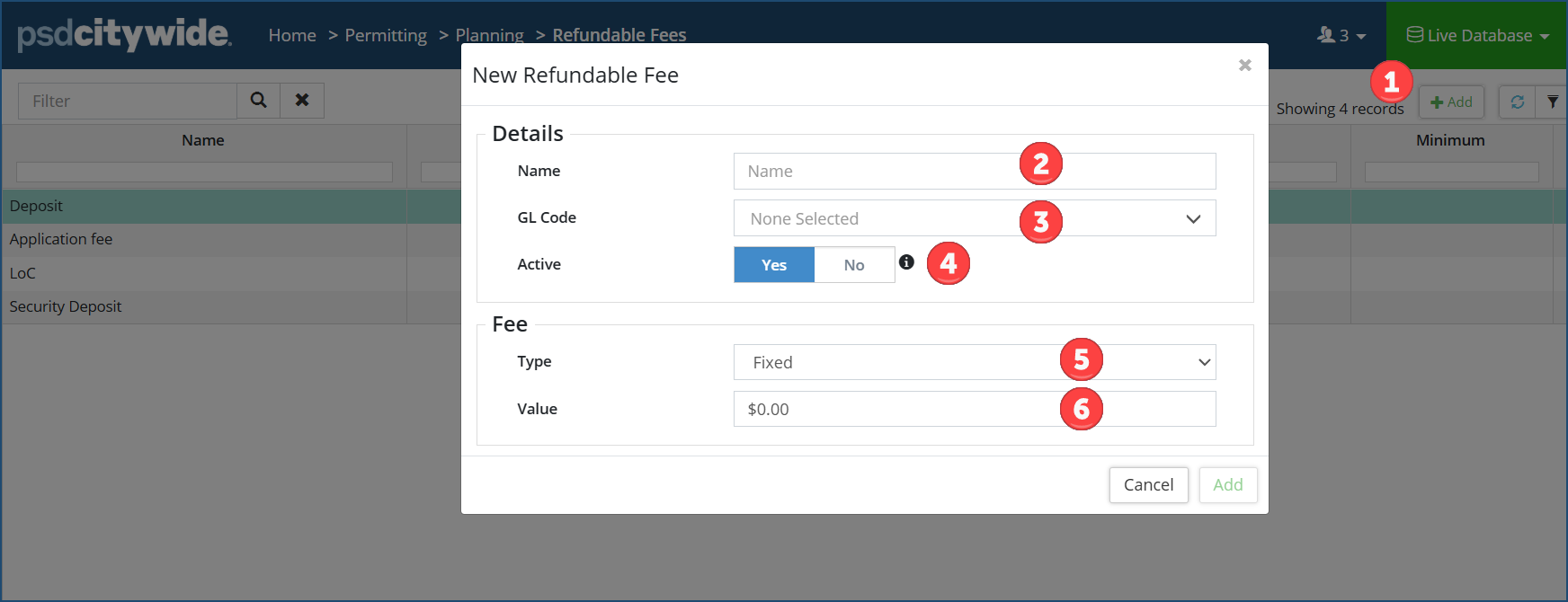
- Give the fee a Name ❷.
- Provide a GL Code ❸ (optional). GL Codes are maintained in the General Ledger Codes.
It is important to select the correct GL Code here in all cases, in that the fees can be exported through the GL Code Report and then imported into your accounting system. Entering the incorrect GL account code here may, when imported into your accounting system, create distortions there.
- Ensure the Active flag ❹ is set to Yes. If set to No, the fee will not be available when creating new permits. “No” might be the setting for a new field to be used some time in the future, or it could be the setting for an existing field that is no longer used (but not deleted, so that data pertaining to it is retained in the system).
- Select the Fee Type ❺. Your options within the remainder of the dialog box will change depending on your choice here.
- Fee Type: Fixed
- Enter the Fixed ($) Value ❻.
- Fee Type: % of Other Fees.
- Enter the (%) Value ❻.
- Fee Type: Per Work Field
- Select the Work Field ❶.
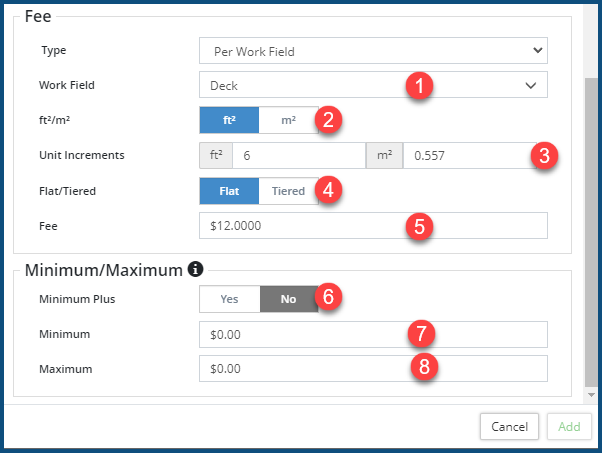
The list that comes up is maintained in Work Fields. The name of the field immediately beneath the Work Field field and the form it takes depends on the work field type and its property setting. - Select the Unit Increments ❸. Unit increments specifies the range within which a flat fee amount would be applied. In the above example, a $12.00 fee is applied for every six square feet--$12.00 for the first six square feet and an additional $12.00 for every addition set of six square feet, including $12.00 for any number of additional square feet (1-5) that exceeds the last multiple of six square feet (e.g., $36.00 for 20 square feet).
- Select whether the Fee is Flat or Tiered ❹. Tiered values involve a calculated (percentage) amount or an entered flat amount which varies from one tier to another.
- If Tiered, refer to the Tiered subsection discussion above.
- If Flat ❺, enter the Fee amount that will apply to each incremental unit (e.g., the $12.00 for each set of six square feet in the above example).
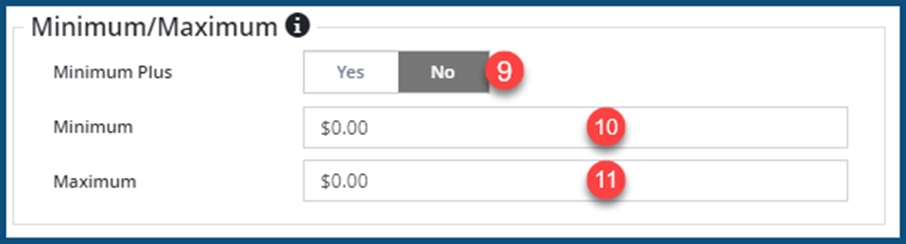
- Set the Minimum/Maximum amounts:
Select Yes for Minimum Plus ❾ rate is to be added to the Minimum rate.
Enter the Minimum ❿ and Maximum ⓫ (calculated or flat) fee amounts.
- Select the Work Field ❶.
- Fee Type: Fixed
- Click on Add .
- Click on the Edit tool
 . The Edit Fee dialog box will appear with the above fields.
 - Make the required changes.
- Click on Edit.
- Click on the Delete tool
 . When prompted, click on Remove.


